

Freddy Purcell covers the latest talk on Martian science.
For the 50th Colloquium we heard from Franziska Reinhard, visiting from Ulm University where they work on various areas in the Philosophy of Science. This talk, however, focussed on the wonderfully interesting niche of palaeontological efforts to find traces of life on Mars.
To establish the background for their talk, Franziska discussed the importance of iteration within the historical sciences, which includes palaeontology, archaeology, and parts of geology. These disciplines face epistemic challenges as they deal with sparse and degraded pieces of evidence that make it challenging to reconstruct the past. Scientists must therefore iteratively build on previous investigations in a slow climb towards more complete understanding, progressively refining their theories. Within this process, different methods of investigating a subject may also be uncovered and scientists have time to reflect on the ambiguous conclusions of previous findings. You may therefore have some idea of why palaeontology on Mars is a difficult undertaking when iteration is so key to the progression of historical scientific understanding.
Unfortunately, Mars is generally considered to be uninhabited these days. However, 4.1-3.7 billion years ago, during the planet’s Noachian Era, Mars is thought to have been habitable, sharing many features with Earth. The Viking I and II missions in 1976 optimistically aimed to discover whether microbial life still remained on Mars by injecting radioactive gas into the ground. The idea being that if microbes were alive, they would release the gas. While the gas was released, there was no trace of organic molecules on Mars’ surface and no other release of radioactive gas. This led scientists to eventually conclude that there is no extant life on Mars.
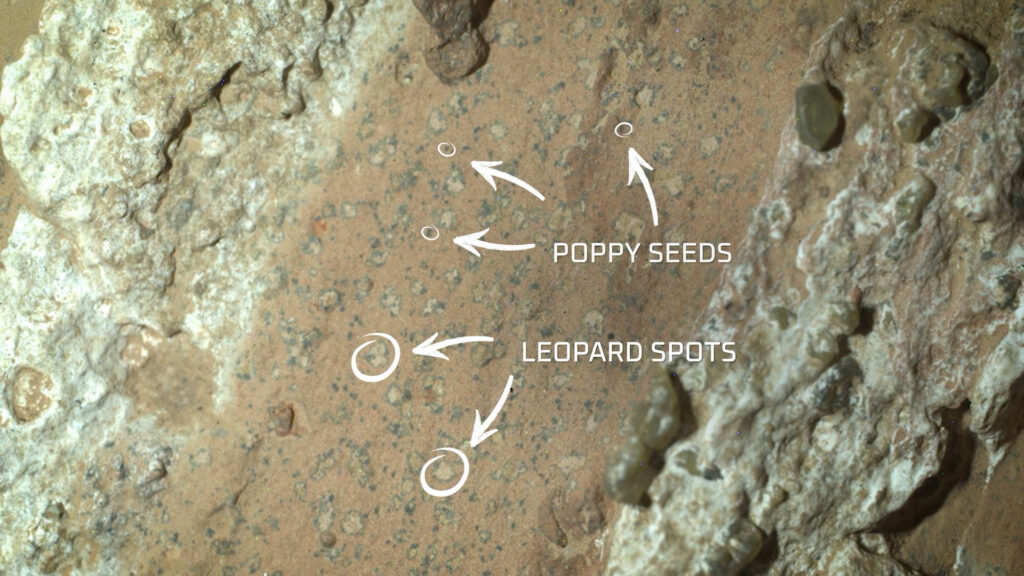
Since then, several other missions have been launched to Mars. including Perseverance in 2021. This rover, with updated equipment, made the exciting discovery of tiny “leopard spots”. These bright dots of rock with dark rings (pictured above) are associated with chemical reactions created by microbial life. Some rocks also contained organic compounds and were rich in iron and phosphate. Although these findings could be explained by volcanic activity, scientists take them to be promising signs of historical life on Mars.
Franziska pointed out that in terrestrial cases you can return to sites and collect additional samples, allowing for repeated experiments and the reinterpretation of findings as part of an iterative process. However, this is not particularly possible on Mars missions as the rovers have fixed instruments, can only collect a limited number of samples, and site revisits are not the most convenient. Franziska therefore argued that scientists ought to engage in pseudo-iteration, to gain the benefits of iteration without being able to perform the ideal life of iterative study. More practically speaking, pseudo-iteration involves greater emphasis on the planning stage as scientists anticipate what kinds of signs of life they are looking for, so build the rovers to have appropriate instruments.
Pseudo-iteration has already been employed in connection to Mars missions through NASA’s BASALT project. Here, on basalt terrain in Idaho and Hawaii that is similar to the surface of Mars, scientists experimented with how rovers would navigate the rocky terrain and identify how microbes colonise volcanic environments. Franziska described how this gives scientists clues on what kind of life might have been present on Mars, how it may have proliferated, and what trace evidence to look for. This allows scientists to prepare for possible outcomes and anticipate what they may find, mimicking truly iterative processes that refine hypotheses. Franziska therefore convincingly argued that this kind of preparatory work is essential for the development of scientific understanding of extreme locations like Mars.
This was a very interesting talk, delivered in a warm and engaging way. So, thank you Franziska! Hopefully there will be a few more colloquiums this summer, so keep an eye out.