

Last week, on the 24th of September, the UoE Philosophy Society kicked off with our first Phil-on-tap, hosted by none other than our university’s Dr Adrian Currie. As the title of the talk suggests, we had the pleasure of hearing about Currie’s latest research focus in direct relation to his new book “The Science of Lost Worlds,” which explores the epistemology of the historical sciences through the lens of Prof. Ichthy, an Ichthyosaur cum palaeontologist attempting to understand mammals in a distant alternative future. In addition to the exciting topic, Currie also shook up the traditional lecture style of our Phil-on-taps, instead opting to give the audience a list of chapter names and then asking us to give random, and often unrelated, prompts for him to link to the chapters, which, as you will see, led to impressive, informative and exciting discourse.
The Science of Lost Worlds
- Prof. Ichthy’s Inaugural Lecture
- The Avalonian Ediacaran
- Artificing
- Grafting
- Anchoring
- Possible Worlds
- Imagined Worlds
- Peculiar Worlds
- Unprecedented Worlds
- Loss and Wonder
Why Is Studying the Deep Past More Difficult Than Studying Recent History?
Before going on to give one of the prompts and how they were connected to the above chapter list, I will first give a bit of an insight into some of the epistemological and methodological challenges encountered by those studying the deep past. To do this, I invite you to consider the difference between studying a mammoth as opposed to a prehistoric creature. The biggest difference here is that the mammoth went extinct very recently in comparison to any of the dinosaurs or other prehistoric creatures; this means that we have better-preserved specimens (such as Yana, the 50,000-year-old infant mammoth found preserved in the thawing permafrost in 2024 with its head, soft tissue and trunk remaining remarkably well preserved (Smith, 2024)) which affords palaeontologists far more physical, genetic and behavioural information than a fossil can. In addition to this, because mammoths went extinct around ten to four thousand years ago, their closest living relatives, being the Asian Elephant, have a genetic divergence from their extinct relatives of around 65% (Rohland et al., 2010); however, when we consider that the closest living taxonomic group to the dinosaurs are modern birds (Aves), it becomes clear that the study of the deep past is far more difficult and requires creative solutions as opposed to the study of recent historic events.
Prompt 1: “Why is Artificer the best Dungeons and Dragons class?”
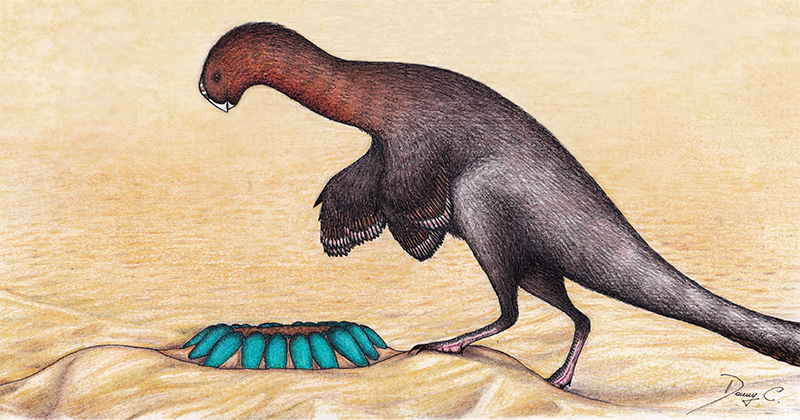
Our first prompt was asked in relation to chapter 5, so to begin, for all the uninitiated out there, an artificer is a half-caster class (meaning they use a combination of magic and weapon-based attacks) in DnD which primarily focuses on building weapons/tools/armour out of mundane objects to overcome any number of challenges within a campaign. To begin, Currie outlined one of the classic dilemmas with playing any half-caster class, which is “should I prioritise spell-craft or weapons?” to illustrate that palaeontologists also struggle with their own similar dilemma of which research methods they should metaphorically unsheathe at any given site or discovery. One such method that aligns very well with the DnD artificer’s toolkit is artificial recreation of prehistoric artefacts such as nests to find out more about the behaviour and life cycle of specific dinosaurs. For example, researchers from Taiwan’s National Museum of Natural Science recreated an oviraptorosaur nest (pictured below) as well as a mock oviraptorosaur to figure out the efficacy of the prevailing theory in relation to their incubation methods. Upon this recreation, they realised that the oviraptorosaur couldn’t have kept all the eggs at the perfect hatching temperature at the same time, leading them to eventually conclude that the dinosaur instead worked with the sun, as well as sitting on the eggs to maintain an even temperature throughout the eggs in the nest (J. Currie, 2026).
Loss and Wonder
For this next section, I will recount how Currie described wonder and loss within the context of both philosophy and the sciences. For some, it seems intuitive to say that the more one learns, the less wonder one sees in the world as they can imperially explain away any phenomena that may leave them wonderstruck. However, for Helen De Cruz in her book Wonderstruck: How Wonder and Awe Shape the Way We Think, she asserts that wonder is more of a habit that should be practised and rehearsed (De Cruz, 2024). It is precisely because wonder is an active emotion that, as we learn, we can see and appreciate, on a deeper level, that which we attend to. To illustrate this more clearly, Currie gave us the example of his interactions with his cat, and how the more he seems to observe his cat in its behaviours, attitudes and idiosyncrasies, the greater the sense of wonder that he feels. Here Currie notes that the deep past itself is a tremendous source of wonder as it forces us to rethink or reform our conceptions of the present and how it came to be. In this sense, looking to the past may be an exercise in wonder that gives us a new way to look at the world around and ahead of us.
Reference List
De Cruz, H. (2024). Wonderstruck how wonder and awe shape the way we think. Princeton University Press.
Currie, J. (2026). How a simulated dinosaur nest revealed prehistoric parenting strategies. [online] Nautil.us. Available at: https://nautil.us/how-a-simulated-dinosaur-nest-revealed-prehistoric-parenting-strategies-1279134 [Accessed 30 Sept. 2026].
Rohland, N., Reich, D., Mallick, S., Meyer, M., Green, R.E., Georgiadis, N.J., Roca, A.L. and Hofreiter, M. (2010). Genomic DNA Sequences from Mastodon and Woolly Mammoth Reveal Deep Speciation of Forest and Savanna Elephants. PLoS Biology, 8(12), p.e1000564. doi:10.1371/journal.pbio.1000564.
Smith, A. (2024). Scientists unveil 50,000-year-old baby mammoth carcass. BBC News. [online] 23 Dec. Available at: https://www.bbc.co.uk/news/articles/cy47xj4lpyzo [Accessed 30 Sept. 2026].